Civic monitoring report
Redevelopment of a confiscated property for the construction of a day center for teenagers
Sent on 28/02/2026 | By TEAM UNBOUND
| @https://x.com/_unbound_kr?s=21
What we found out
Project objectives Tweet
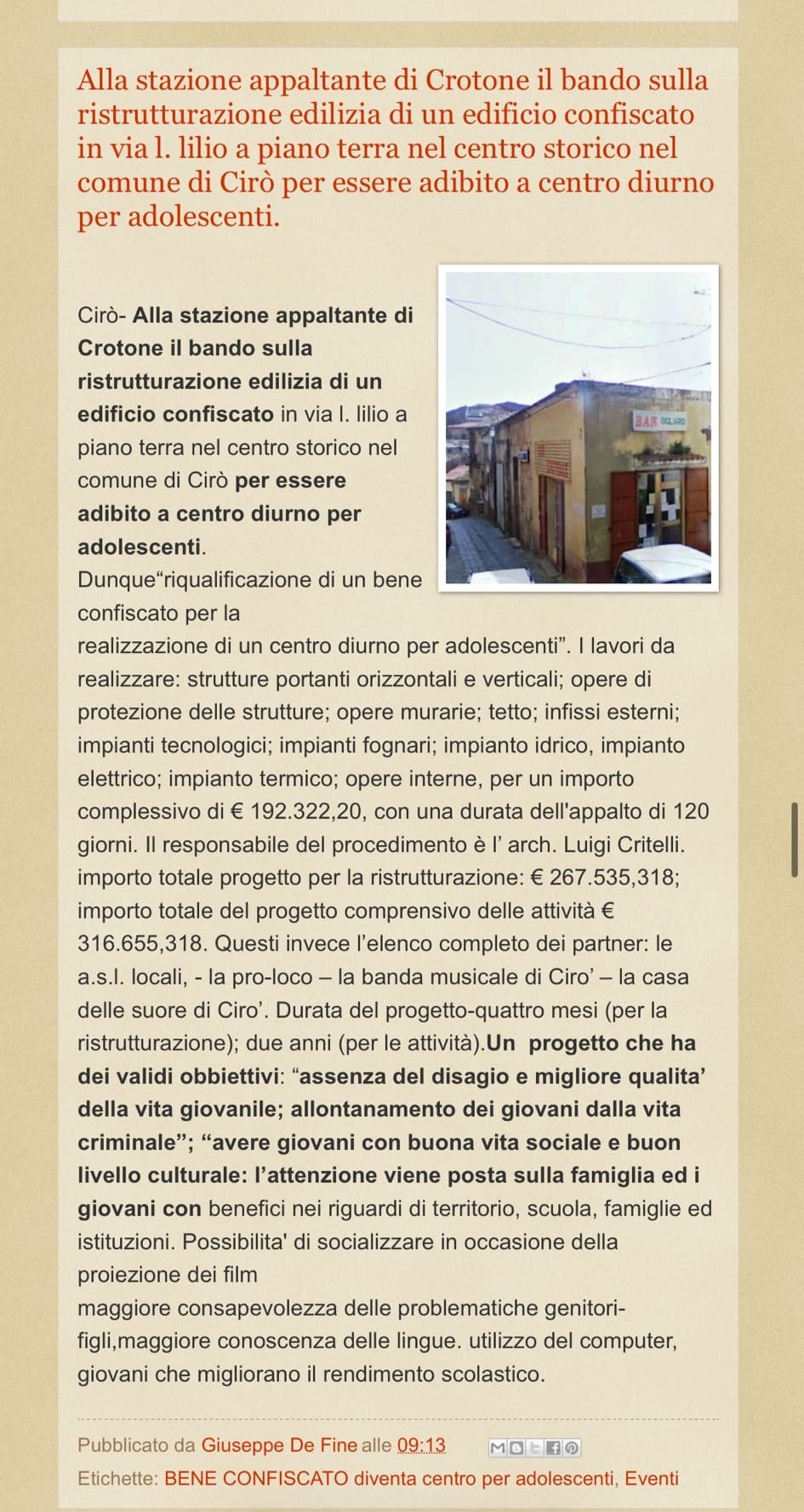 The project titled “Redevelopment of a Confiscated Asset for the Creation of a Day Center for Adolescents” concerns the conversion of a building located in the heart of Cirò Superiore, confiscated from Silvio and Peppe Farao, leaders of the Farao–Marincola clan. The building, which previously housed the “Bigliardi” bar—a symbol of territorial control and the power of local organized crime—was renovated and transformed into a Day Center for adolescents. Management was entrusted to the Parish of Santa Maria de Plateis, which has turned it into a reference point for educational, recreational, and pastoral activities aimed at young people and families in the community. The importance of this intervention goes beyond symbolism. Transforming a former criminal meeting place into a parish center represents the victory of the State and the community over illegality. It marks the transition from “clan control” to “service for the common good.” Offering alternative spaces for socialization in difficult areas reduces fertile ground for mafia recruitment and influence, promoting a culture of participation. The project falls under the European Regional Development Fund (ERDF) programming 2007–2013, Axis IV – Quality of Life and Social Inclusion. Its overall objective, within the National Strategic Framework, was to promote an inclusive society and ensure security conditions to permanently improve the context factors that directly foster development. The specific objective was to enhance the quality and equity of social and labor participation through greater integration and accessibility of social protection, care, training, and employment systems, with particular attention to equal opportunities and anti-discrimination measures.
Foreseen activities
The project involved the redevelopment of a confiscated property to create a day center for adolescents. The administrative procedure began with Regional Government Resolution No. 160/2010 – Integrated Regional Development Project – Assets Confiscated from Organized Crime. Work was scheduled to begin on April 2, 2012, and conclude on July 20 of the same year. The project did not only involve physical renovation but also included a social management plan through its reuse by the Parish of Santa Maria de Plateis. The parish provides daily support to children and adolescents from vulnerable backgrounds through social animation activities, digital inclusion initiatives to reduce the digital divide, and safe recreational spaces replacing the former “mafia billiard hall.” The renovation phase included upgrading systems and removing architectural barriers to ensure accessibility. This was followed by the management phase after the formal handover of the property to the parish.
Project origin
The origin of the project and the stakeholders involved tell a story of profound transformation for the community of Cirò. The project stems from the final confiscation of a property located in the historic center of Cirò, previously linked to the brothers Silvio and Giuseppe Farao, leading members of the Farao–Marincola clan. The property was a bar/billiard hall. It was not simply a commercial business, but a symbolic place of territorial control, where the clan’s economic and social power was exercised. After the confiscation, carried out as part of the judicial operation “Galassia,” later reinforced by subsequent investigations such as “Stige,” the asset became part of the property holdings of the Municipality of Cirò. Instead of leaving it abandoned, it was decided to allocate it for social purposes in order to return it to the community. The success of this reuse is the result of collaboration between public institutions and religious entities. The Municipality of Cirò, as the owner of the confiscated asset, issued a public notice for the allocation of the building, ensuring the necessary bureaucratic process for its social reuse. Today, the Parish of Santa Maria de Plateis is the main managing body. Thanks to the work of Father Massimo Sorrentino and the parish volunteers, the local Church has taken responsibility for bringing the space to life, with the support of the Archdiocese of Crotone–Santa Severina. Law enforcement authorities played a fundamental role during the eviction and handover phase, ensuring that the transfer and management of the property took place safely. Today, the premises host the Day Center for Adolescents named after Monsignor Alessandro Vitetti—a choice rich in symbolic and educational meaning for the community of Cirò. This act is not merely a formality, but represents the very heart of the project’s message of legality. Naming a confiscated asset after a figure such as Monsignor Vitetti serves to overwrite the memory of the place. Where once the shadow of crime and clan power prevailed, there is now the name of a man who dedicated his life to service, humility, and faith. It is a clear message: the State and the local Church are reclaiming the space for noble purposes. Monsignor Vitetti, known for his profound culture and dedication to teaching, was a point of reference for entire generations of people from Cirò. Choosing his name means rooting the project firmly in the local territory. The dedication to Monsignor Vitetti is the instrument through which the asset is definitively “liberated” (unbound) from its criminal past, becoming a beacon of light for the future of Cirò Superiore and for the true protagonists of this project—the adolescents who live in a town where the symbol of wrongdoing has been transformed into a laboratory of active citizenship. This interweaving of the State (which confiscates), the Municipality (which allocates), and the Parish (which manages) is what makes the project solid and deeply rooted in the territory.
Beneficiaries
The beneficiary of this project is not a single entity, but a plurality of stakeholders who benefit from the transformation of a symbol of criminal power into a common good. The true protagonists of the project are the adolescents and young people of Cirò. The center is dedicated to them, aiming to combat educational poverty and promote healthy social interaction by offering an alternative to “bars” or the streets—places where the risk of exposure to micro-criminality or deviant environments is higher.
Through the activities carried out at the center, young people from Cirò can express their talents in a place that belongs to them. At the same time, parents in Cirò have access to a reliable educational presence, such as the Parish, where they can entrust their children during their free time, knowing they are in a safe and stimulating environment. The Parish of Santa Maria de Plateis, although the managing body, is itself a beneficiary, as it gains a physical space in which to carry out its pastoral and social mission—something that would otherwise require prohibitive rental or construction costs. The reopening of a confiscated asset is also a moral benefit for the entire population. Every time a citizen walks past the center and sees young people playing instead of criminal affiliates gathering, they perceive a victory of the State and the rule of law. Institutional and territorial beneficiaries should also be considered. The Municipality of Cirò benefits in terms of social services. The center performs a function of “proximity welfare” that the Municipality, often with limited resources, would struggle to provide on its own. Effective reuse is proof of the success of Law 109/96, the law regulating the social reuse of confiscated assets. Every hour of activity in that center confirms that the fight against the ’ndrangheta does not end with a court sentence but continues within the community. In summary, the ultimate beneficiary is the future of Cirò. By transforming the Farao family’s “property” into the young people’s “heritage,” the transmission of the mafia model to new generations is interrupted, fostering a new class of aware and free citizens.
Context
The context in which the monitoring project of the confiscated asset in Cirò operates is characterized by a complex layering of historical, criminal, and social elements. Analyzing it means understanding why the transformation of that “billiard bar” is not just a news event, but a development of historic significance for the area. Cirò has historically been the headquarters of one of the most powerful ’ndrangheta clans: the Farao–Marincola clan. This clan operates not only locally but also leads a “Locale” with branches throughout Northern Italy and in Germany, as revealed by Operation “Stige.” The context is one of entrepreneurial crime that for decades has suffocated the legal economy by imposing prices and suppliers and controlling strategic sectors such as wine production, waste management, and food distribution. In this environment, a bar directly managed by family members (such as Silvio and Giuseppe Farao) was not merely a business, but an information hub and a symbol of territorial sovereignty. The project operates in the heart of Cirò’s historic center, a medieval village of rare beauty but marked by the typical fragilities of Calabria’s inland areas. Youth migration to Northern Italy or abroad is constant. The lack of healthy recreational centers often leaves the young people who remain without alternatives, making them more vulnerable to the appeal of criminal “power.” Educational poverty data further aggravates the situation. According to INVALSI surveys (2023/2024), nearly 57% of lower secondary students in the Crotone area complete their studies with inadequate literacy skills—the highest rate recorded in Italy. In addition to early school leaving (which in Calabria stands at around 10.8%, improving but still above the EU average), there is concern about “implicit” dropout: students who graduate without acquiring the minimum basic skills needed to face the job market or university. In Southern Italy, the rate of absolute poverty among minors is close to 16%. In Crotone, the provincial capital with the highest density of residents under 18, this translates into constant pressure on social and parish services. In a landscape where childcare services are scarce and cultural venues limited, the social reuse of this asset represents, in Cirò, the only free alternative to the “street” or to contexts of marginalization. In similar settings, access to music, IT, or sports workshops is limited.
The parish therefore becomes the only educational outpost beyond the school system. Cirò lives in constant tension between a burdensome past and a strong desire for redemption. The project takes place at a historical moment of strong State reaction. Following recent arrests, a “criminal power vacuum” has emerged that institutions are attempting to fill with social services. In the Crotone area, the Church has assumed a significant role of social support. The decision of the Parish of Santa Maria de Plateis to openly take responsibility for a confiscated asset is a clear stance that breaks any possible grey areas of ambiguity. Ultimately, the project operates in a frontier context. Every activity carried out in the center—homework support, a game of table football, a prayer meeting—takes on enormous political and social value because it occurs in a “liberated” place. The success of the project is measured precisely by its ability to normalize legality in a context that for too long considered illegality to be normal.
Progress
The project benefited from a total public investment of approximately €227,000, mainly funded through the European Regional Development Fund (ERDF). The project, as the mayor of Cirò claims, has been completed in terms of renovation and is in an advanced or completed stage regarding the disbursement of funds. The Calabria Region acted as the programming authority, while the Municipality of Cirò was the beneficiary and the implementing body responsible for the works. The renovation phase of the former Bigliardi bar has been completed. The building has been fully redeveloped. The property was formally handed over to the Parish of Santa Maria de Plateis, through Resolution No. 85 of June 19, 2008, which assumed responsibility for its social management. Field checks carried out by Team Unbound for the ASOC contest show that the center is operational. The functions of a day center for adolescents are active, with support and parish-based social animation activities in place. Monitoring highlights that the asset has already begun to fulfill its role as a stronghold of legality, removing young people in the historic center from the risks of the streets and offering a concrete alternative to the criminal models of the past. The project has successfully moved from the “construction site” phase to the “service to the community” phase. The current challenge, as highlighted in the report, concerns maintaining the center’s vitality and ensuring its capacity for long-term social sustainability, reiterates the prosecutor Domenico Guarascio.
Results
The outcome of a monitoring project on a confiscated asset such as the one in Cirò cannot be measured solely in terms of “renovated bricks,” but above all in the change in social perception and the continuity of the services provided. The first visible result is the physical recovery of the building. A place once designed for consumption (a bar) and control has become a multifunctional space for protected social gathering. The asset has shifted from being an “exclusive” place, accessible only to those connected to certain circles, to an inclusive space open to all citizens without distinction. Monitoring shows that the Parish has succeeded in stabilizing a consistent educational offering. The number of adolescents who choose the center as an alternative to the street is the most concrete indicator. If the center is “alive,” the project has succeeded. The fact that the citizens of Cirò regularly enter a building once owned by the Farao family without fear indicates that the mafia-related stigma has been weakened. The presence of the Church and public institutions within the confiscated property demonstrates that the State has “taken root” permanently—not only through police operations, but through services. The project proves that the synergy between the Municipality and the ecclesiastical body works. The completion of the entire process (confiscation – allocation – renovation – opening) is in itself a significant achievement in a region where many confiscated assets remain unused for years.
Weaknesses
None
Strengths
The strengths of this monitoring and reuse project are numerous and operate on different levels: symbolic, educational, social, and territorial. The transformation from the “Bigliardi” bar, often a place of territorial control and private meetings for the Farao clan, into a center for adolescents is an extremely powerful signal. The State and the Church are telling the community that this space no longer belongs to criminal power, but to the community. Taking an asset away from the leaders of a powerful clan such as the Farao–Marincola and turning it into a public good breaks the image of the clan’s invincibility. Offering a healthy alternative to adolescents in a difficult territory is the most effective form of fighting the mafia. The center provides a space for social gathering that removes potential recruits from criminal activity. Being managed by the Parish of Santa Maria de Plateis, the project combines youth aggregation with an ethical path of active citizenship. The parish, in fact, is a deeply rooted institution that enjoys the trust of the people. This facilitates access for young people and families who might feel intimidated by attending a confiscated asset managed solely by public institutions. The project is not an isolated initiative, but is embedded in the fabric of the diocese and the local community, ensuring continuity that purely municipal or state-run projects often struggle to maintain (continuity of volunteers, 8x1000 funds, etc.). Another strength lies in the fact that no new building was constructed; instead, an existing one was regenerated, reducing environmental impact and giving new life to a part of the town that would otherwise have remained degraded or under seizure for years. The project works because it strikes the ’ndrangheta at its weak point: social consensus and control over the future. Transforming a place of wrongdoing into a place of hope is the most profitable investment a community like Cirò can make. In a town where for years bars or certain private clubs were the only meeting places (and often instruments of territorial control), the Parish of Santa Maria de Plateis offers a safe “public square.” Its strength lies in its ability to engage families in Cirò who, despite living in a difficult context, seek a protected environment for their children, free from criminal influence. Cirò has often made headlines for police operations (such as “Stige”). The reuse of this asset is a strength because it helps change the narrative of the town. It demonstrates that Cirò is not only a “land of clans,” but a community capable of managing the common good. The adolescent center becomes a flagship initiative to showcase externally, attracting the attention of national networks. The confiscation from prominent figures such as the Farao family carries enormous weight in such a depopulated town. Its connection to the local context transforms the center from a simply restored building into a driver of urban and social regeneration. In Cirò, this project is not merely providing a service; it is restoring dignity to a community that for too long has been identified solely through the lens of crime.
Risks
Given the nature of the asset, confiscated from the Farao family, and the socio-economic context, the most concrete risk is that, in the long term, the facility may lack the resources to cover operating costs. Relying exclusively on parish volunteer work is noble but fragile: without a stable funding plan, the center risks underutilization. Additionally, in contexts with a high mafia presence like Cirò, there is always the risk of environmental pressures or intimidating acts of vandalism. If the community and institutions let their guard down, the asset could suffer symbolic retaliation aimed at demonstrating that territorial control still belongs to the old clans, discouraging young people from attending. The project risks becoming a “cathedral in the desert” if it fails to create a solid network with schools and other local associations. If the center is perceived solely as a closed parish space rather than an open civic hub, its ability to impact educational poverty among all of Cirò’s youth will drastically decrease. The depopulation of small Calabrian towns is also a critical factor: if the most active young people leave Cirò for study or work, the center could find itself without “vital energy” and without a new generation of civic leaders capable of managing it. The challenge will be to monitor not only the walls but the social vitality of the center, pushing institutions not to consider the work complete with the ribbon-cutting, but as an ongoing commitment requiring funds, protection, and constant participation.
Ideas and solutions
To increase the effectiveness of such a symbolic project in Cirò, it is not enough for the asset to be merely “open”; it must become a pulsating engine of civic life. Its effectiveness grows if the asset is not perceived solely as “the parish hall,” but as a resource belonging to everyone. To attract adolescents today, the center must offer skills that are useful for the future, countering the temptation of easy gains from criminal activity. Introducing courses in coding, robotics, or ethical social media management. Creating a desk to help young people discover legal professions in the area (e.g., modern winemaking, sustainable tourism) by bringing into the center the testimonies of ethical entrepreneurs from Cirò. Effectiveness is maximized when the community feels like the “guardian” of the asset. For this reason, the youths attending the center could be involved in managing a bulletin board (physical or digital) showing how funds are spent and which objectives have been achieved, organizing annual events to tell the history of the asset (who owned it and how it is used today) to keep historical memory and awareness of civic redemption alive. Participating in calls for proposals (e.g., Erasmus+ for international youth exchanges) could bring young people from all over Europe to Cirò, breaking the cultural isolation of the village.
Investigation method
How was the information collected?
- Web research
- Visit to the project's location, documented by pictures or videos
- Interview with people responsible for the project's planning
- Interview with the users and/or final beneficiaries of the intervention
- Interview with other types of people
- Interview with people responsible for the project's implementation
- Interview with political leaders
Domenico Guarascio, Prosecutor of Crotone
Mario Sculco, Mayor of Cirò
Main questions
1. Crotone and its province are scattered with assets seized from clans, yet many of these remain “cathedrals in the desert.” What strategy should be used to ensure that confiscation is not just a bureaucratic act but becomes a tool of a healthy economy that restores dignity and clean work to citizens? (Domenico Guarascio, Prosecutor of Crotone)
2. Cirò has a complex history linked to criminal presence. Do you believe that creating a cultural or educational center in a confiscated property belonging to a boss could represent the definitive signal of breaking with the past and reclaiming the territory for the State? (Mario Sculco, Mayor of Cirò)
Main answers
1. This is a difficult question to answer, because over time the legislator has found various solutions. Without the so-called third sector—that is, without associations, without volunteer work by young people like you, without the involvement of civil society—the use of confiscated assets does not work. Ultimately, direct management by the local authority suffers from all the flaws and difficulties of public administration at the local level, especially in Calabria. Then you have to consider, and these are both news reports and judicial data, how Calabrian municipalities suffer endemically from a whole series of problems. They do not have the financial resources to manage even minimal services, and sometimes there are infrastructure problems. So you can imagine how difficult it is for a municipality like Cirò, Isola, or Crotone itself to still handle the valorization of a confiscated asset. This system does not work, so it is clear that the initiative by the association must be made more attractive. Trust must be built in the territory, and the judiciary must be involved in the use of confiscated assets, because often even the “third sector” is infiltrated by the ’ndrangheta, and ad hoc associations are established to regain illicitly seized assets. If civil society does not reclaim public spaces in its territory in a strong and proactive way, even the saga of confiscated assets can be undermined by a whole series of inefficiencies that the Italian public administration unfortunately still retains.
2. Certainly. Taking back these confiscated assets and giving them a new appearance, a new life, is a sign of civil revival, a cultural revival, far from criminal activities. The physical reclamation of a property that belonged to a boss is not only a signal of rupture but tangible proof that the State not only hits crime in the wallet but also destroys its social prestige, restoring dignity to the territory.