Civic monitoring report
Wi-Life Station
Sent on 5/03/2026 | By Team RAILS
What we found out
Project objectives Tweet
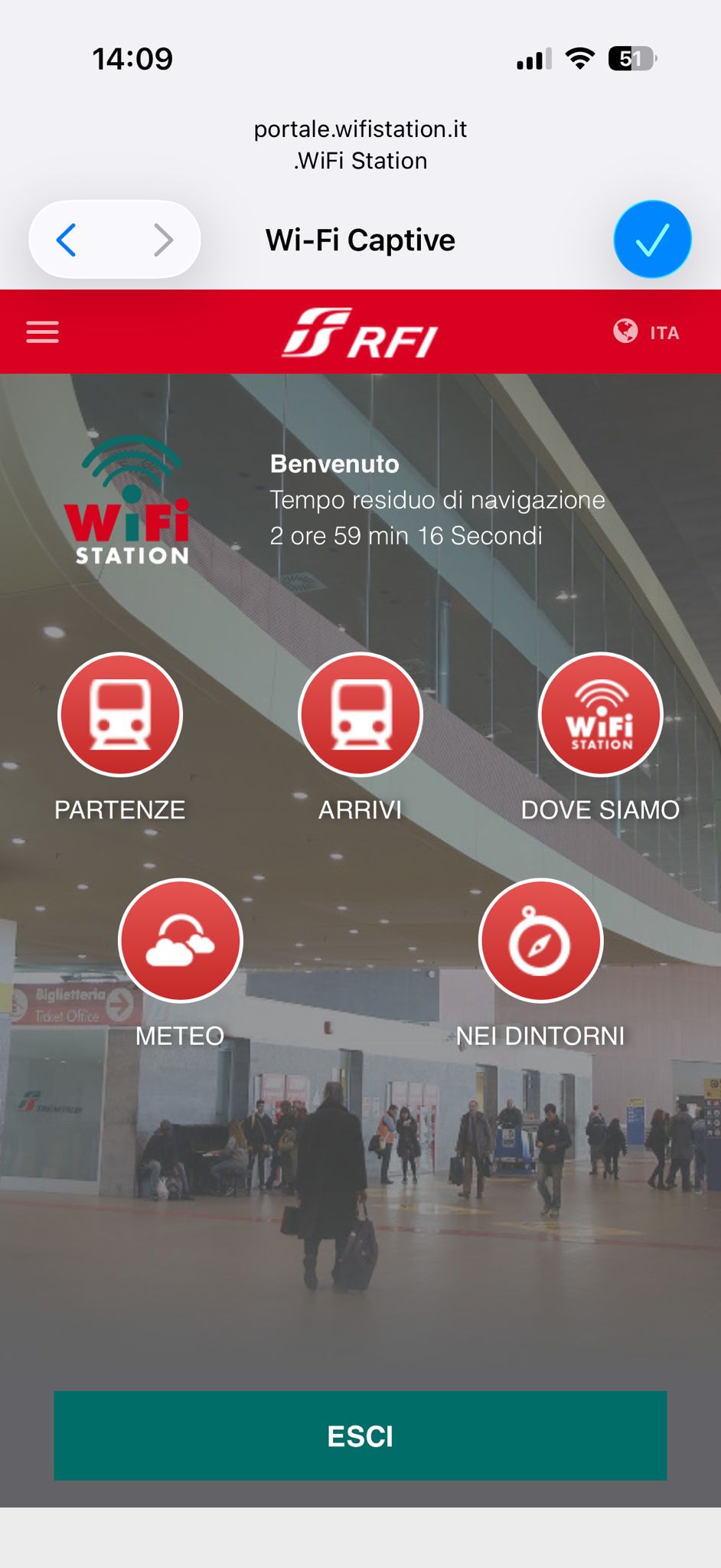 The Wi-Life Station project aims to modernize railway stations by introducing advanced digital services and free intelligent Wi-Fi networks. The project focuses on stations located in the Italian Convergence Regions: Campania, Calabria, Puglia, and Sicily.
The main objective is to improve regional mobility and intermodal transport, making it easier for travelers to move between different means of transportation such as trains, buses, and urban mobility systems.
Through the installation of technological infrastructure and digital platforms, the project creates a “New Station Portal”, which provides travelers and citizens with useful information and services while they are in the station.
The project also supports the goals of the PON FESR Infrastrutture e Reti, specifically the improvement of regional mobility, better modal integration, and stronger multimodal connections.
This project is important because it helps transform railway stations into smart mobility hubs, improving the travel experience and making transportation systems more efficient and accessible.
Foreseen activities
The project includes several technological and digital activities aimed at improving station services.
The main planned activities are:
• Installation of smart Wi-Fi networks in railway stations.
• Creation of a digital station portal accessible to passengers.
• Development of web applications that support intermodal transport.
• Implementation of systems able to monitor passenger flows within stations.
• Introduction of digital orientation services to help users navigate inside the station.
• Integration of digital services offered by different stakeholders (transport operators, service providers, etc.).
These activities are expected to be implemented gradually during the project period, with infrastructure installation followed by the activation of digital services.
Project origin
The project was financed through the PON FESR “Infrastrutture e Reti” Program, a European structural fund program aimed at improving infrastructure and mobility in Italy.
More specifically, it contributes to the objective:
“Improvement of regional mobility, modal integration, and enhancement of multimodal connections.”
The administrative procedure that led to the project funding is:
PRATT2134 – Projects of Axis II and III
The type of administrative procedure was a “Manifestation of Interest”, meaning that organizations could propose projects aligned with the objectives of the European program.
Public institutions, infrastructure managers, and transport stakeholders participated in the development of the project. However, it is possible that some groups of citizens or regular users of the stations were not directly involved in the planning phase, as the project mainly followed institutional and administrative procedures.
Beneficiaries
Several groups can benefit from the outcomes of the project:
• Train passengers, who will have access to free Wi-Fi and digital services.
• Commuters and daily travelers, who can receive better information about transport connections.
• Tourists, who can easily access navigation and information services in stations.
• Citizens, who may use station services as digital access points.
• Transport operators and service providers, who can use the digital platform to offer new services.
However, some groups could be partially excluded, such as people with limited digital skills or those without smartphones or digital devices.
Context
The project operates in regions of Southern Italy that historically face infrastructure and mobility challenges. Railway stations in these areas often lack advanced digital services and efficient integration with other transport systems.
Improving mobility is an important priority in European and national policies. The Wi-Life Station project fits within broader strategies aimed at:
• modernizing transport infrastructure
• promoting smart mobility
• improving intermodal transportation
• supporting regional development
The project is also connected to wider public strategies such as:
• national transport infrastructure policies
• regional mobility planning
• sustainable urban mobility plans (PUMS) where available.
By introducing digital services and better information systems, the project helps railway stations become more efficient, connected, and user-friendly, contributing to the modernization of transportation systems in the regions involved.
Progress
During the verification of the project called Wi-Life Station, elements of significant misalignment emerged between the public information available and what was observed on site and reported by the central administration. On the OpenCoesione portal, the project is recorded with both planned and actual start dates of 01/06/2017, the last publicly reported payment dated 31/12/2023, and total recorded expenditure of €3,647,786.09 out of a total funding allocation of €7,496,725.00. However, the central headquarters of Rete Ferroviaria Italiana informed us that the project was completed in June 2025. Shortly before this recent interaction with RFI, this information was also added to the public OpenCoesione portal, although at the beginning of the monitoring process only the expected completion date of 26/06/2025 was indicated. Despite this update to the dates, the public data regarding payments has not been updated, and the financial framework therefore remains fixed at the amount recorded at the end of 2023, resulting in a lack of correspondence between the administrative status reported online and the internal communications of the responsible authority. At the same time, the central office reported that the intervention also included the railway station of Acireale and that the service had been installed there; however, a technical inspection carried out on site confirmed the absence of the declared infrastructure and service. This circumstance raises doubts both about the classification of the activities as “completed” and about the actual correspondence between formal delivery and the operational presence of the service.
Results
The Wi-Life Station project, although officially completed according to the central offices of Rete Ferroviaria Italiana in June 2025, presents partial and uneven results across the territory. On one hand, the project led to the installation of Wi-Fi infrastructure in several railway stations in Southern Italy, theoretically providing travelers with free internet access and potentially benefiting connectivity and digital inclusion (source: RFI central office communication). On the other hand, on-site inspections, particularly at the station in Acireale, revealed the absence of the declared service, highlighting a discrepancy between official data and operational reality (source: technical site inspection, date of observation).
From a utility perspective, the project has the merit of expanding network access in railway contexts, potentially improving the experience of commuters and occasional travelers. However, overall effectiveness is limited by the uneven operational status of the infrastructure, the need for continuous maintenance, and the verification of connection quality. The lack of updates on payments and financial progress on OpenCoesione (source: OpenCoesione portal, data updated as of 31/12/2023) also suggests that administrative management and reporting do not fully reflect the actual results.
Supporting these observations, a survey conducted on 180 people in the province of Catania highlights further critical issues regarding service usage: the sample includes 101 people under 25 years old and 79 people over 25 years old, and most respondents use the train rarely or never (43.89% never, 42.78% less than once a month, about 13% daily or weekly users). Regarding awareness of the Wi-Life Station service, the vast majority of respondents are not aware of it; only a very small portion knows and uses the service, while a slightly larger group knows it but does not use it. The main barriers reported by those who know the service but do not use it are the perceived lack of need and, to a lesser extent, concerns about the security of public internet connections (6 people).
In summary, although the project has produced tangible results in terms of installed infrastructure and potential Wi-Fi access, its actual impact on the territory is incomplete and uneven. To increase effectiveness and ensure full achievement of the objectives, it would be necessary to implement regular technical inspections, checks of service usability in stations, routine maintenance, information and digital literacy campaigns for users, and updated administrative transparency.
Weaknesses
The Wi-Life Station project, while representing a useful initiative to promote connectivity access in railway stations in Southern Italy, presents several critical issues that deserve attention. One of the main concerns regards the quality of the infrastructure and the maintenance of the service, as the mere installation of Wi-Fi hotspots does not guarantee a stable and fast connection without continuous monitoring, updates, and regular technical interventions, a situation that can be particularly challenging in smaller or peripheral stations. Another limitation is economic sustainability: even if the service is free for users, it entails costs related to installation, management, security, and maintenance, and without a stable economic model based on partnerships, sponsorships, or public funding, it may be difficult to ensure continuity. The mere availability of Wi-Fi does not guarantee genuine digital inclusion, as some segments of the population may lack the necessary skills to fully leverage the opportunities offered by the network; without digital literacy initiatives, the social impact of the project could be limited. Additionally, there are cybersecurity and data protection issues, as public networks are more vulnerable to interceptions or unauthorized access, requiring encryption, authentication, and monitoring systems that entail specific costs and expertise. Other limitations concern the actual reach of the service, given that stations primarily serve commuters and travelers, while those who do not regularly use rail transport may not benefit, and the disparity in service quality between stations, with large urban stations better equipped than peripheral or smaller ones, which could receive a less efficient service. In summary, without careful management, reliable infrastructure, digital training, and economic sustainability, the project risks failing to fully translate its potential into concrete and lasting benefits for the territory.
Strengths
The Wi-Life Station project, aimed at providing an inclusive Wi-Fi service in railway stations across Southern Italy, presents several strengths that highlight its relevance from both a technological and social-territorial perspective. First of all, the initiative significantly contributes to the reduction of the digital divide, a phenomenon that is still present in several areas of Southern Italy where access to stable and free internet connections is not always guaranteed for the entire population. The installation of Wi-Fi hotspots in railway stations allows citizens, commuters, and travelers to easily access the internet even without a personal connection or sufficient mobile data, thus promoting access to information, online services, and the opportunities offered by the digital world. Another important strength concerns the improvement of the travel experience within railway stations, which are places characterized by waiting and transit times that can be used in a more productive or enjoyable way thanks to the availability of free connectivity; through Wi-Fi, users can check travel updates, work remotely, communicate with others, or access entertainment content, making the station environment more modern, functional, and aligned with the needs of contemporary mobility. The project also holds significant value in terms of social inclusion, as it enables people with fewer economic resources or limited digital skills to approach and use online services, which today represent an increasingly important tool for accessing public services, educational opportunities, employment activities, and health or administrative information; in this sense, providing free connectivity in strategic public spaces helps encourage greater participation in social and economic life. Another key strength lies in the enhancement of railway stations as multifunctional territorial hubs, since these spaces are no longer seen solely as transit points linked to transportation, but can take on a broader role as community reference points equipped with digital services that improve the accessibility and usefulness of public environments. Finally, the project may also generate positive effects on the economic and tourism sectors, as better connectivity in stations contributes to making Southern Italian cities more attractive to visitors, students, and mobile workers, while also creating opportunities to integrate additional digital services such as territorial information platforms, promotion of local businesses, or intelligent systems for managing passenger flows. Overall, Wi-Life Station can therefore be considered an initiative capable of combining technological innovation, digital inclusion, and improvement of public services, contributing to the modernization of railway infrastructure and to the social and economic development of Southern Italy.
Risks
The main risks that could compromise the effectiveness of the Wi-Life Station project span both technical and organizational aspects. First, the lack of regular maintenance and continuous monitoring could reduce the quality of the Wi-Fi connection and compromise service availability, particularly in peripheral or less frequented stations where operational attention may be lower.A second risk is economic sustainability: without a stable funding model or public/private partnerships, the costs of managing, securing, and updating the infrastructure could become unsustainable, leading to service interruptions or reductions.Additionally, the project could be affected by operational disparities between stations, with large urban stations being better equipped than smaller or peripheral ones, resulting in uneven impacts on users and undermining the goals of digital inclusion.
There are also risks related to cybersecurity and data protection: public Wi-Fi networks that are not adequately secured can be vulnerable to interception or unauthorized access, requiring specific expertise and additional costs to maintain acceptable security standards.
Finally, there is the risk related to user adoption: if the service is not adequately promoted or if users lack the necessary digital skills, the availability of Wi-Fi will not translate into genuine digital inclusion.
Ideas and solutions
To increase the effectiveness of the Wi-Life Station project and ensure the full achievement of its final objectives, it is necessary to act on multiple levels simultaneously, integrating technical, organizational, and complementary interventions. First of all, public data should be updated and synchronized, ensuring that portals such as OpenCoesione report in real time the actual status of the project, including completion dates, payments made, and operational status of the infrastructure, thereby increasing transparency and enabling civic monitoring. It is essential to carry out precise technical inspections at all included sites through standardized site visits with photographic documentation, geolocation, and functional testing of the Wi-Fi service to guarantee the actual operability of the infrastructure. Effectiveness can be further enhanced through complementary interventions, such as the installation of digital information infrastructure and signage within stations, the development of digital services accessible via Wi-Fi (transportation apps, interactive maps, tourist services), and training for both staff and users on proper service usage. At the same time, maintenance and continuous monitoring plans should be established, with structured reporting to prevent service interruptions and degradation of quality. Engaging the local community by collecting feedback from citizens and end-users allows for the identification of potential issues, preferences, or needs that were not initially considered, thereby improving the service’s suitability for actual users. Improving coordination between administrative levels, including RFI central offices, local offices, and monitoring bodies, reduces discrepancies between official data, internal communications, and operational reality. Finally, where gaps are detected, as in the case of Acireale, targeted corrective actions should be planned, including missing installations, infrastructure upgrades, or expansion of services to new strategic areas. Together, these actions and conditions make it possible to enhance the project’s effectiveness, ensuring coherence between technical implementation, administrative transparency, and the real usability of services.
Investigation method
How was the information collected?
- Web research
- Visit to the project's location, documented by pictures or videos
- Interview with the Managing Authority of the Programme which financed the project
- Interview with the users and/or final beneficiaries of the intervention
- Interview with other types of people
- Interview with people responsible for the project's implementation
- Interview with political leaders
The people we interviewed fall mainly into two categories: on one hand, the service implementers, meaning those directly involved in the installation, management, and maintenance of the Wi-Fi infrastructure at railway stations; on the other hand, the end users, that is, the travelers who actually use the service. In particular, we had the opportunity to ask detailed questions to users who frequently use the train, focusing on aspects such as service awareness, perceived quality, ease of access, and overall user experience. This allowed us to understand both the actual usage of the service and any issues perceived by the users. Subsequently, we engaged with RFI representatives to gather more detailed information about the origin, planning, and implementation of the project, the technical choices made, and the management strategies adopted, thus obtaining a comprehensive overview that integrates user perceptions with the internal data and procedures of the responsible entity.
Main questions
Are you aware that a free service has been installed at this station that provides Wi-Fi connectivity and also includes a station information portal, designed to improve the traveler experience and provide information on available services? (travelers)
What is the current status of the Wi-Life Station service at Acireale station? Are you aware of its relocation and, if so, will the service be installed and operational in the new location? (RFI contacts)
Main answers
My experience with the Wi-Fi service and information portal at this station is limited. In fact, I was initially unaware that a free service was available, so until recently I had never used it. After discovering that the service existed, I began to inquire about it, and even though I knew I could use it, I never actually did, mainly due to concerns about the security of public connections and the possible exposure of my personal data. I know that some users use the service without any problems, while others, like me, despite being aware of its existence, prefer not to use it because of these concerns. Then there are users who use it regularly, but my personal experience falls somewhere between those who know about the service but don't use it for security and caution reasons.
Based on the information and checks carried out, the Wi-Life Station service is currently installed in the municipality of Acireale. Therefore, contrary to what we have been told, we are not aware of any relocation or movement of the station to another location. Consequently, we are unable to determine whether the possible absence or inactivity of the service may actually be linked to a possible transfer of the infrastructure. Further checks will therefore be necessary to clarify the situation more precisely and understand the current status of the service.