Civic monitoring report
TESTEAT
Sent on 5/03/2026 | By Lucija Mirošević i Tonka Žuvela
What we found out
Project objectives Tweet
 The TESTEAT project is focused on strengthening the role of enogastronomy heritage as an important part of sustainable tourism.
The project encourages mutual valorization of Italian and Croatian gastronomy and the development of an innovative tourist offer adapted to a modern consumer’s needs.
The project is important because gastronomy takes great part in tourism offer and at the same time there are more and more people with special food habits or health issues like vegetarian, vegan, celiak disease, lactose intolerance etc. This projects makes great difference by making local communities aware of this issues and together with them project partners create gastronomic offer that can meet the needs on the market.This project aims to help local communities develop economically while preserving traditional food culture in the way that it takes traditional recipes and adjust the recepie to new dietary needs.
A special highlight is put on the education and training of future and existing workers in tourism, including students, teachers and professionals. The project also encourages the principals of sustainability, circular economy and digitalization.
Goals of the project:
- include socio-economic change in tourism by educating the workforce through cross-border activities
- focusing on circular economy, digital skills, and the evolving demands of modern tourism, while nurturing enogastronomy heritage
- enhance and adapt enogastronomy heritage to modern tourism demands to adapt to special needs
- strengthen and sustain the cross-border area
- promoting integrated tourism and raising awareness among tourists, stakeholders, and local communities
- support policy change and sustainable development in the IT-HR area by establishing guidelines and action plans to preserve and promote the cross-border enogastronomy heritage across the programme territory and beyond
Shorter - the main goals of the project are to analyse the gastronomic heritage of the cross-border area, develop innovative tourism products, improve the skills of workers in the tourism sector, and create guidelines for future development of gastronomy tourism in Italy and Croatia.
Specific project outputs:
new model of an integrated tourist offer designed to nurture intangible enogastronomy heritage through pilot actions in rural and urban areas, respecting local resources and promoting circularity considering modern tourist demands
Foreseen activities
Planed activities are planed in 4 work packages (WP) and spread over 5 periods.
Each period is lasting 6 months. Period 1 is from 1-6th month, period 2 is from 7-12th month, period 3 is from 13 -18 month, period 4 is form 19 -24 month and period 5 is form 25 to 30 month.
This is short version of activities and timeframe:
WP1 – Enogastronomy heritage in function of specific beahaviour patterns in tourism
- building of the TESTEAT enogastronomy innovation HUB (PERIOD 1)
-Adriatic cross-border enogastronomy situation analyses (PERIOD 1,2)
-Joint cross-border tourism behaviour patterns (PERIOD 2 AND 3)
- Integrated enogastronomy tourism offer framework (PERIOD 3)
- Digital tools and activities for enhancing enogastronomy heritag (PERIOD 1,2,3,4,5)
WP2- Upskilling and reskilling the tourism workforce
Increasing the skills of teachers and students (PERIOD 2, 3)
Training of the tourism workforce (PERIOD 2,3)
Promoting a culture of lifelong learning for tourism workforce (PERIOD 2,3)
WP3-Creation of cross border integrated tourism offer
Common approach for designing innovative and integrated tourism offer (PERIOD 3)
Pilot implementation of new models of integrated tourism offeR (PERIOD 4)
Evaluation of the created models (PERIOD 4)
WP4 – Developing guidelines and action plans to enhance Italian and Croatian enogatronomy heritage
Assessment of the project’s solutions and development of transferable guidelines and recommendations to enhance IT-HR enogastronomy heritage (PERIOD 4)
Developing of the TESTEAT HUBs’ Strategy and action plan to guarantee durability and sustainability of project’s outputs and result (PERIOD 5)
Promoting and transferring TESTEAT core solutions and messages to the cross-border area and beyond (PERIOD 5)
Project origin
The TESTEAT project was developed as part of the Interreg Italy–Croatia cross-border cooperation programme, which supports cooperation between institutions from the two countries. The project was selected through a public call for project proposals and is funded mainly by the European Regional Development Fund (ERDF).
The project was designed by a partnership that includes universities, public institutions, development agencies and training centres from Italy and Croatia.
The Agency for Rural Development of Istria (AZRRI) is the lead partner and is responsible for coordinating the project and managing communication with programme authorities. Other partners are:
City of Venice (COV), University Ca’ Foscari of Venice (UNIVE), University of Pula (UNIPU), CIVIFORM, Dubrovnik Development Agency (DURA) and Municipality of Ston. Basicly, 2 Development agencies, 2 Universities, 2 Vocational schools and 2 Cities.
Partners are responsible for research, training activities and the development of tourism models. Stakeholders from the tourism sector are also involved through workshops, meetings and innovation hubs.
Some groups may not have been directly involved in the initial design of the project, but they can participate during the implementation phase through events and project activities.
Beneficiaries
The project benefits several groups of stakeholders:
- tourists and visitors - they will benefit from improved tourism experiences that combine gastronomy, culture and local traditions in innovative ways. This is specialy important for tourists and visitors but also local people who have special food preferences or needs
- tourism professionals such as chefs, restaurant workers, tour operators and destination managers - they will benefit from training activities and new knowledge that will help them adapt their services to modern tourism trends.
- students and young people in vocational and higher education - they will benefit from educational programmes and training opportunities related to sustainable gastronomy and tourism.
- local communities and producers - they will benefit because the project promotes regional food products and strengthens local economic development through tourism.
- Public institutions and policymakers may also benefit from the project’s guidelines and action plans, which provide recommendations for sustainable tourism development and cultural heritage protection.
No specific social groups are excluded from the project. On the contrary, they are included because the main goal of the project is to ajust the gastro offer to special groups of people like vegans, vegetarians, people with intolerance to gluten, lactose etc.
Context
The project addresses common challenges faced by the Italy-Croatia programme area. These regions possess a rich intangible enogastronomy heritage, including traditional products, dishes and cooking techniques that are deeply connected to local culture and identity.
However, tourism in many of these areas still relies heavily on seasonal “sun and sea” tourism, and there is a need to diversify tourism offers and develop more sustainable and year-round tourism models.
Another challenge is the need for better skills and knowledge among tourism workers, especially in responding to modern consumer demands, dietary requirements and sustainability challenges such as food waste. Raising awarnes and sensibility about this special needs is very important.
The project covers several regions including Istria County, Dubrovnik-Neretva County, Veneto Region and Friuli Venezia Giulia, and also involves cooperation with other Italian regions.
TESTEAT also builds on previous European projects and initiatives such as KeyQ+, SlowFood-CE, S.LI.DES., MEDFEST and Tourism-friendly Cities, which focused on promoting gastronomic heritage and sustainable tourism development. Project is in line with:
EU Strategy for the Adriatic and Ionian Region, European Green Deal, European Digital Strategy, European Industrial Strategy and European Skills Agenda for Sustainable Competitiveness, Social Fairness and Resilience
Progress
Based on the information collected, we have come to the conclusion that the project is nearing completion (31st of July 2026. is the deadline) and that all planned activities have been completed succesfully. We collected information through:
- Secondary data research (online research)
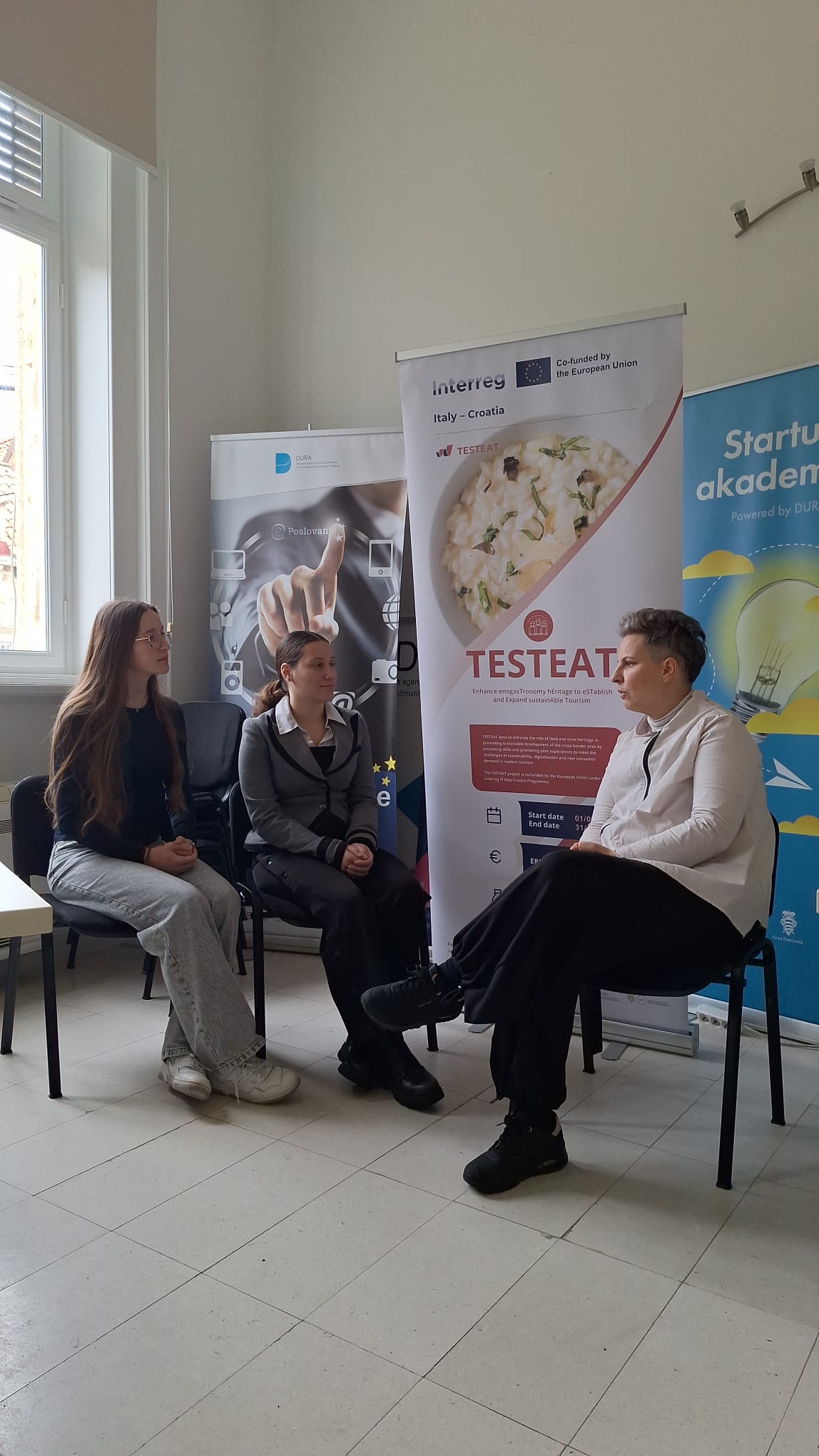
- Live interview with Mia Hrnić (project manager) during a civic monitoring visit
- Surveys with project partners
- Listening to interviewed users and participants of the education and pilot actions program
Results
We had interview with Mia Hrnić, Testeat project manager during civic monitoring in Dubrovnik. During this interview we got all the important questions about the project answered and we also stayed in touch even after the visit. We sent surveys on email to other Croatians project partners (Azzri, Ston municipality and Universitie of Pula), they were also very supportive and answered quickly. And we listened to feedbacs of interviews users (students and public) that we were given by the project manager. Here are the results:
- Hub iniciated - this was very usefull because the hub members contributed a lot to design of the activities in order to be well organized and produce good results. the members of the hub were project partners, torust work force representativse, users representatives (school teachers), food experts like chefs and one nutricionist.
- the analysis and mapping of the gastronomic heritage of the cross-border region made at the begining of the project – traditional recepies to be adapted to special needs were chosen
- development of a blueprint for innovative gastronomic tourism offers, adaptation of traditional dishes to modern food trends and dietary needs succesfully done – more than 40 recepies adapted
- TESTEAT online tool created - https://testeat.eu/hr - this is a great platform that can be also upgraded even after the project finishes. Many people can use it out of curiosity or need. Also restaurants and hotels that are not part of the project can benefit and learn. In the future this platform may even grow with new recepeis. In this waythe awarness of special needs is raising but also acceptance and creativity.
- regional gastronomic events and pilot activities that test new tourism models succesfully organized – education, worshop and events wer organized for school teachers and students, and worshops and public events were organized by students and teachers for public and children from 6 to 10 years old.
- guidelines and action plans that can help policy makers and tourism organisations improve gastronomy tourism in the future created
- users very satisfied with participation in the project
Weaknesses
In the conversation with project partners we dicovered that there are different opinions about adaptation of traditional recepies and that may be a weak point because the adaptation is the core of this project. If people in the gastronomy sector are resistant to changing traditional recipes or adapting them to modern dietary trends that can influence the success of the project.
There is also a challenge of coordination between many partners from different countries, different institutions and speaking different language. It is important that every partner respects deadlines.
Other weaknesses:
- Possibility of limited participation of local stakeholders
- Possibility of low participation in workshops
- Possibility that guidelines and strategies will not be fully implemented by local authorities and tourism operators.
Strengths
The strengths of the project (what we really liked) are:
- Great topic (gastronomy - food that connects people and respect tradition)
- Strong (experienced) and multidisciplinary partnership (2 universities, 2 deelopment agencies, 2 cities and 2 schools) that covers all aspects for succesfull creation and implementation of planed activities
- Italian and Croatian cross-border cooperation, possibility to exchange knowledge, experiences and best practices related to tourism and gastronomy.
- creation of innovation hubs helps connect different stakeholders and encourages collaboration and the best way of organizing activities
- strong focus on sustainability, including reducing food waste, promoting circular economy practices and supporting local food production.
- education and training activities, which help develop skills among tourism professionals and students, ensuring long-term impact and sustainability of the project results.
- Raising awarness of special needs and preferences – unfortunately more and more people have food intolerance and it is important to make special gastro offers for them too.
- Lots of workshops (for children, students and teachers and tourists workforce) that are educative and inspiring.
- Creative side of the project – adaptation of traditional gastronomy to modern tourism trends - that is also great for keeping the tradition alive
- Online platform – adapted traditional recepies are easily found on the platform
Risks
Several risks could affect the effectiveness of the project.
The main risk is insufficient participation of tourism stakeholders, such as restaurants, tourism providers and local business. They may not participate because they are not aware of the project but also because they are not ready to improve or they might believe that traditional recipes should not be modified, which could make innovation more difficult.
This limit the practical implementation of the project results.
Another risk relates to changes in tourism demand, which may affect the success of new tourism products developed during the project.
Additionally, the success of the project depends on the long-term cooperation between partners and institutions, which may be challenging after the project funding period ends.
The risks anticipated in the application form of the project are:
Ideas and solutions
To increase the effectiveness of the project, several actions could be considered:
- stronger communication and promotion activities could help raise awareness about the project results among tourism professionals, local communities and tourist. Promotion can be made on national tv, radio and social networks, but also direct promotion in schools. In this way more people and profesionals will get to know about the project and they can use the results and even add their contribution and create new ideas and products.
- the project outputs, such as the blueprint of innovative recipes and tourism models, could be widely disseminated through digital platforms, tourism networks and educational institutions.
- cooperation with tourism schools, universities and vocational training centres could further support the development of skills and knowledge related to sustainable gastronomy tourism.
- public authorities and policymakers could integrate the project’s recommendations into local and regional tourism strategies, ensuring that the results continue to be implemented even after the project ends.
Our suggestion would be to introduce this project to more schools in Croatia. Then profesors and students can than make smaller projects to raise the awarness of special food needs and habits and they can make their own workshops and public events.
Also digital platform with adapted recepies can be shared through social media and it can be upgraded by including local people who can send their traditional recepies to be adapted and published.
Investigation method
How was the information collected?
- Web research
- Visit to the project's location, documented by pictures or videos
- Interview with the Managing Authority of the Programme which financed the project
- Interview with people responsible for the project's planning
- Interview with the users and/or final beneficiaries of the intervention
- Interview with people responsible for the project's implementation
To obtain quality information we prepared and conduced interview with Mia Hrnić - she is Testeat project financial manager and she works in DURA – Dubrovnik Development Agency. Her role in the project is to coordinate activities between partners.
We also sent a survey by e-mail to representatives of other partner organizations:
- Ston Municipality - Nives Babić, project manager
- Juraj Dobrila University of Pula - dr. sc. Anica Dobran Černjul (Faculty of economics and tourism "Dr. Mijo Mirković")
- AZRRI (Agency for Rural Development of Istria) as the leading partner - Valentina Buršić - Expert Advisor for Development and International Programs/project manager
All partners were very supportive and responded very quickly. They also gave us all the feedbacks that they collected after educations and pilot activites. So we have feedbacks from students and from visiters of public events.
Main questions
How does the TESTEAT project contribute to the preservation and promotion of enogastronomy heritage in the cross-border area?
(asked to project representatives from DURA and AZZRI)
What benefits do you expect the project to bring to students, tourism professionals, and the local community?
(asked to project representatives from DURA and AZZRI)
Main answers
Two main answers from the interviewees
Answer 1:
The interviewees explained that the TESTEAT project helps preserve traditional gastronomy while adapting it to modern tourism trends. By organizing workshops, training sessions, and cooperation between tourism stakeholders, the project encourages the exchange of knowledge and promotes local food heritage as a key element of sustainable tourism.
Answer 2:
According to the interviewees, the project will benefit students and tourism professionals by providing new educational opportunities and practical knowledge about sustainable tourism and gastronomy. At the same time, local communities can benefit from increased tourism visibility and economic opportunities related to gastronomy tourismTwo main answers from the interviewees