Civic monitoring report
MAPA (Marine Adriatic Parks)
Sent on 13/03/2026 | By BlueWaves Team
| @bluewavesboccardi
What we found out
Project objectives Tweet
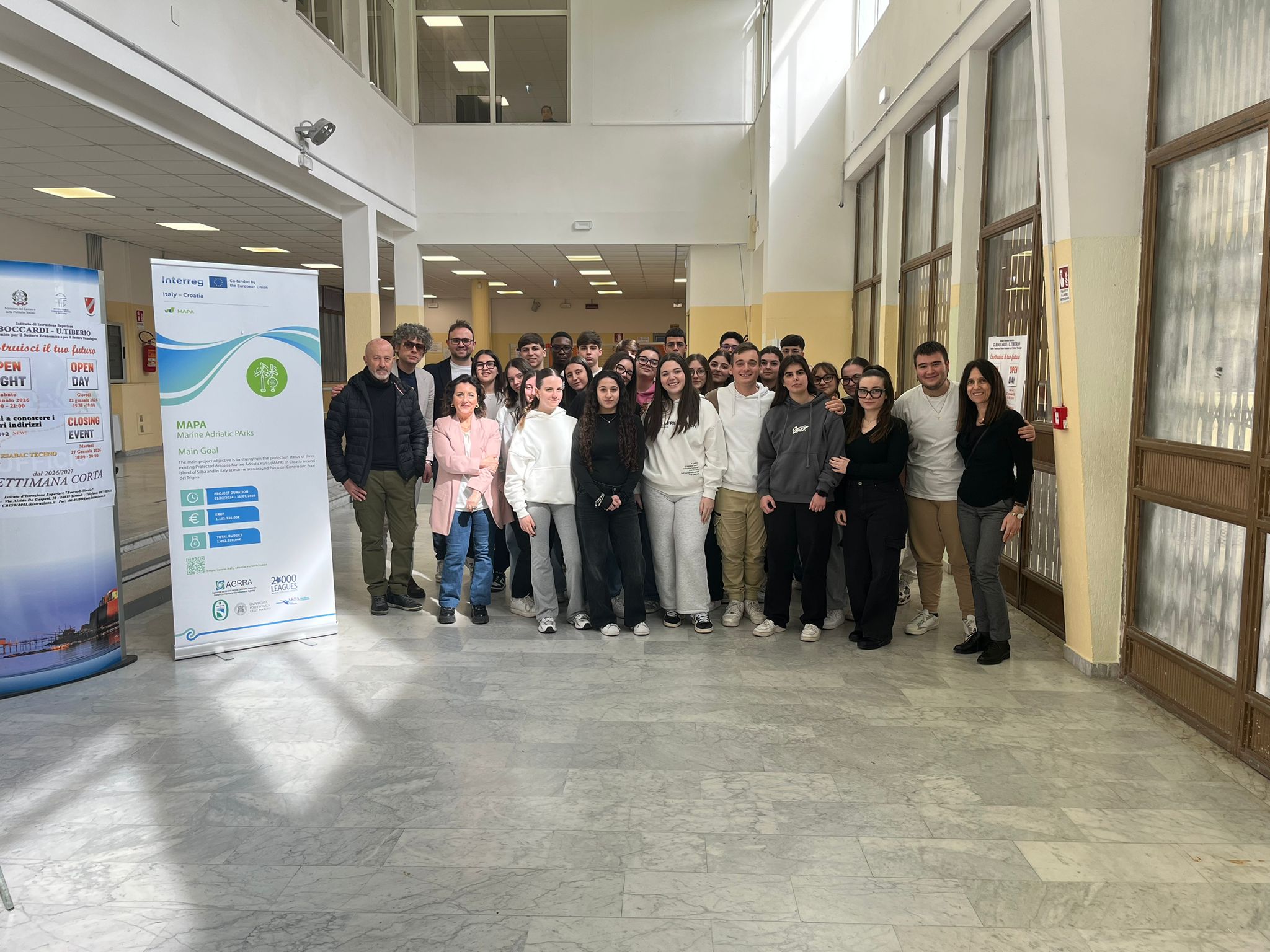 MAPA, an acronym for Marine Adriatic PArks, is a project funded under the Interreg VI-A Italy-Croatia 2021–2027 programme, bringing together five partners from Italy and Croatia to protect and enhance three marine areas of exceptional ecological value in the Adriatic: the island of Silba in Croatia, the Conero Park in the Marche region, and the Foce del Trigno at the border between Molise and Abruzzo. The project runs for 30 months (February 2024 – July 2026) and has a total budget of €1,402,920, 80% funded by the European Regional Development Fund (ERDF).
The project is particularly important because the Adriatic Sea is a fragile ecosystem shared by two countries, exposed to growing threats: degradation of marine biodiversity, plastic and nutrient pollution, coastal erosion, river drought, and the impacts of climate change. These threats do not stop at national borders and require coordinated responses between Italy and Croatia. Without integrated action, there is a risk of irreversible loss of priority habitats such as Posidonia oceanica meadows, the calcareous reefs of the Conero, and the wetlands of the Foce del Trigno, with serious consequences for the sustainable blue economy and for local communities that depend on the sea for their livelihoods and quality of life.
Main Objectives
MAPA pursues a high-level strategic general objective: to strengthen the protection status of the three Adriatic marine areas through shared transboundary co-management strategies, making local communities active protagonists in marine conservation. This objective is broken down into four specific goals, each addressing a concrete territorial need:
- enhancing the conservation status of priority habitats and species through shared transboundary strategies;
- developing digital tools for surveillance and civil protection;
- organising joint training programmes for operators, authorities, and citizens;
- promoting regenerative practices that support sustainable coastal traditions.
Foreseen activities
The activities of the MAPA project are structured across three main Work Packages, spanning the 30-month duration (February 2024 – July 2026):
WP1 – Strengthening Management and Connectivity: includes a comparative legislative analysis of the Italian and Croatian regulatory frameworks for marine protected areas, mapping of priority habitats, development of the Joint Strategy and Transboundary Action Plan, and the creation of the MAPA Digital Platform for the interactive monitoring of species and habitats.
WP2 – Community Engagement in Marine Conservation: includes the organisation of MAPA Days in the three pilot areas, joint capacity building programmes for fishers, tourism operators and citizens, and citizen science activities open to public participation.
WP3 – Partnerships with Key Stakeholders: involves the establishment of Local Cooperation Councils in each of the three areas, pilot actions to strengthen local key actors, and the development of responsible eco-tourism models and sustainable marine resource management.
Project origin
The MAPA project originated from the first standard call of the Interreg VI-A Italy-Croatia 2021–2027 programme, published in November 2023 by the Veneto Region as Managing Authority, with a total allocation of €80 million in ERDF funding. MAPA was selected under Specific Objective RSO2.7 — nature protection and biodiversity — receiving a grant of €1,402,920, of which 80% is covered by the ERDF.
The partnership was built through a transboundary co-design process launched before the publication of the call, making use of the official Interreg partner search portal, transnational webinars, technical working tables in Ancona and Zadar, and bilateral meetings held both virtually and in person. The five partners — AGRRA, UNIVPM, ARPA Molise, Društvo 20.000 milja, and the Conero Park — developed a coherent proposal by capitalising on the results of six previous Interreg projects in the marine and environmental sector.
In terms of participation, the process involved institutional bodies, environmental agencies, and local authorities from the three pilot areas. However, some categories directly affected by the project — small-scale fishers, micro tourism operators, and grassroots local associations — did not actively participate in the definition phase, having been considered primarily as recipients of the actions rather than as co-authors of the proposal.
Beneficiaries
The final beneficiaries of the MAPA project are structured across multiple levels, from local to transnational. Small-scale and professional fishers in the three coastal areas are the most direct beneficiaries: the protection of marine habitats ensures the long-term restoration of fish stocks and enhances traditional sustainable fishing practices. The pilot fishery-tourism actions also offer concrete opportunities for income diversification. Tourism operators — diving centres, nature guides, eco-tourism facilities — benefit from the promotion of the three areas as quality destinations for environmental tourism. Residents in the municipalities of the three pilot areas benefit from cleaner waters, less eroded coastlines, and a better-protected natural heritage. Students and young people in coastal schools are strategic beneficiaries, as future stewards of the Adriatic territory and active participants in citizen science activities. Local public institutions — municipalities, regions, and management bodies — acquire concrete governance tools: a Joint Strategy, an Action Plan, a Digital Platform, and Local Cooperation Councils. In a broader sense, the entire Adriatic ecosystem benefits from the project.
However, some categories remain on the margins of direct benefits: small family-run businesses without structured associative networks, due to a lack of adequate participation tools and multilingual communication.
Context
The MAPA project operates within the context of the Adriatic Sea, a fragile and semi-enclosed ecosystem exposed to growing threats: degradation of marine biodiversity, plastic and nutrient pollution, coastal erosion, overfishing, and climate change. These pressures endanger priority habitats such as Posidonia oceanica meadows, the calcareous reefs of the Conero, and the wetlands of the Foce del Trigno, with direct consequences for the blue economy and the coastal communities of Italy and Croatia. These environmental pressures are compounded by institutional fragmentation that hinders the coordinated management of protected areas: none of the three pilot areas yet has formal recognition as a Marine Protected Area with its own management body and dedicated resources.
MAPA fits within an articulated system of public strategies: at European level it is consistent with the EU Biodiversity Strategy 2030, the Marine Strategy Framework Directive (MSFD), and the EUSAIR macro-regional strategy for the Adriatic-Ionian area. At national level it is aligned with the Italian Ecological Transition Plan and national marine management plans. At local level it integrates with the coastal civil protection plans of the Molise, Abruzzo, and Marche regions.
The project capitalises on the results of six previous Interreg programmes — AdriaClim, MPA-Engage, MPA-Adapt, GIREPAM, ADRIREEF, and POSBEMED2 — and is complementary to projects currently underway such as Digital Plan, InnovaMare, JOINABLE, and Mare Skill, all funded under the same Interreg VI-A Italy-Croatia 2021–2027 programme.
Progress
Based on the interviews and documents collected (ARPA Molise), the project is currently ongoing and has reached an advanced stage of implementation, with the majority of planned activities already completed or nearing completion.
The project was officially launched on 1 February 2024 and will conclude on 31 July 2026, with a total duration of 30 months. At the time of this monitoring report (March 2026), the project is in its final year of implementation, with approximately 5 months remaining until completion.
On the transnational activities front, three MAPA Days have been held — community engagement and scientific monitoring events carried out in the three pilot areas: the first in Silba (Croatia, July 2024), the second at the Conero Park (Italy, January 2025), and the third at the Foce del Trigno (Italy, May 2025). Each event engaged local communities, fishers, tourism operators, and public institutions in citizen science and environmental awareness activities.
In July 2025, the Mid-term Conference was held in Termoli, serving as the official project progress review, with the participation of the five partners, local institutions, and schools involved in environmental education activities. On that occasion, the first results of marine habitat monitoring and the draft Joint Strategy for the management of the MAPA areas were presented.
On 30 January 2026, a Memorandum of Understanding (MoU) was signed in Termoli between the partners and local authorities, formally enshrining the institutional commitment to transboundary protection of Adriatic marine protected areas beyond the duration of the project. The signing of the MoU represents one of the most significant outputs of the project in terms of long-term sustainability and governance. The Bluwaves team was officially invited to actively participate in the event. A summary of the proceedings is provided in the attached file.
Results
Based on the information gathered (interviews with MAPA and LAG focal points, and with the Mayor of Montenero), the MAPA project (February 2024 – July 2026) is in its final implementation phase and is proceeding regularly in line with the project timeline.
Partial results achieved:
- MoU signed in Termoli (24 January 2026): institutional commitment to transboundary protection beyond 2026
- Three MAPA Days completed: Silba (July 2024), Conero (January 2025), Foce Trigno (May 2025), with habitat datasets collected
- Mid-term Conference in Termoli (July 2025): draft Joint Strategy presented
- Comparative legislative analysis D.1.3.1 and habitat datasets available in the official library
- MAPA Digital Platform currently in testing phase
From our perspective, MAPA has demonstrated that Italy and Croatia can collaborate to protect a sea that knows no national borders. The signing of the MoU and the MAPA Days represent the most tangible and measurable results, while the Digital Platform and the Joint Strategy have the potential to generate structural impacts that we hope will prove lasting. Sharing the concerns expressed by the various economic operators interviewed, we too have doubts about whether adequate funding will be secured beyond 2026.
Still to be completed by 31 July 2026 are the final Action Plan, the finalised version of the Platform, and the fourth MAPA Day at the Foce del Trigno, but the project appears well on track towards achieving its main objectives.
Weaknesses
When we visited the Foce del Trigno and spoke with local people, we discovered something that surprised us: almost no one knew what MAPA is. For a project that aims to engage local communities, we believe there is still a great deal of work to be done on the communication front — perhaps moving away from official channels towards something closer to people's everyday lives, such as social media or town square events.
Speaking with fishers, we came to understand that taking part in a MAPA Day is an experience they genuinely value. However, they also told us that when it comes to making important decisions about the future of the sea, they feel more like spectators than protagonists. In our view, it would be important to find ways to involve them more meaningfully, because those who live by the sea every day have something unique to contribute.
Looking at the budget, we noted that UNIVPM receives 28% of the resources (€393,500), while the Conero Park — which works directly in the field — has only 9% available (€130,600). We understand that scientific research is fundamental, but we found ourselves wondering whether allocating somewhat more resources to those who concretely manage the territory would not make the project even more effective.
The last thing that gave us pause is that, despite all the work carried out by MAPA, the Foce del Trigno is still not an official Marine Protected Area. The MoU signed in Termoli is an important step, and we were moved to be present for it, but written commitments alone are not enough. What is needed is a real management body, with clear rules and dedicated funding, that will continue to protect this area even after the European project has ended.
Strengths
We were greatly struck by the concrete collaboration between Italy and Croatia: five different organisations — a university, environmental agencies, an NGO, and a park authority — from two countries have worked together to protect a sea that knows no national borders. The Memorandum of Understanding signed in Termoli, in our presence, represents a genuine commitment by local institutions to continue conservation efforts even after European funding comes to an end. We believe this could address the classic problem of EU projects that die at the point of closure, although the concern remains that a change in local administration could cause the project to lose the relevance it holds today.
The MAPA Digital Platform will allow anyone — fisher, tourist, student — to monitor species and habitats in real time. It is not a tool for experts alone, but something accessible to everyone.
We also greatly appreciate the fact that MAPA does not start from scratch: it builds on the results of six previous Interreg projects (AdriaClim, MPA-Engage, ADRIREEF, and others), translating them into concrete actions and thereby multiplying the impact of public funding.
Finally, we are convinced that MAPA is not solely about environmental protection: it can become a catalyst for creating sustainable livelihoods for fishers through fishery-tourism, promoting quality tourism, and raising awareness among young people. It is a model that could work for the entire Adriatic.
Risks
After the site visit, the interviews, and the study of the documents, we believe that MAPA is progressing well. However, there are some concrete challenges that could make it difficult to sustain the results achieved beyond July 2026.
The most immediate risk concerns funding. The MoU signed in Termoli is a serious commitment, but without a clear financial plan for the post-project phase, who pays for the sensors, the platform servers, and the monitoring activities? Without guaranteed resources, some activities risk coming to a halt.
The MAPA Digital Platform is a valuable tool, but it requires continuous updates and dedicated staff. We have seen that similar tools developed by other European projects become unusable within a few years. A decision needs to be made now about who will be responsible for it once the project closes.
Climate change is a challenge that cannot be ignored. Rising sea temperatures, acidification, and increasingly severe storms threaten the very habitats that MAPA is working to protect. The Joint Strategy will need to be ready to adapt to rapidly changing scenarios.
In summer, the Conero and Silba are overwhelmed by tourists. If no effort is made to steer tourism towards more sustainable choices — fewer motorboats, more fishery-tourism and nature-based experiences — ecosystems could be damaged precisely during the months when they are most vulnerable.
For the Foce del Trigno, the path towards recognition as a Marine Protected Area is still a long one. Without a stable management body and dedicated funding, genuinely protecting this area will require serious and coordinated commitment between Molise and Abruzzo.
The greatest challenge of all, however, is a single one: ensuring that the promises of the MoU become concrete reality, day after day, even when the European funding has run out and the spotlight has moved on.
Ideas and solutions
The most urgent proposal concerns the official recognition of the Foce del Trigno as a national Marine Protected Area, with a dedicated management body, a binding regulatory framework, and stable resources. Without this formal step, the scientific and institutional work carried out by MAPA risks leaving no lasting impact on the territory.
During the site visit, we noticed a complete absence of on-site communication: we propose bilingual panels with QR codes along the nature trail, to make MAPA visible and accessible to residents and tourists alike.
Finally, to avoid discontinuity after July 2026, we call on the partners to immediately launch a new Interreg project focused on the operational management of the three areas, capitalising on the tools already developed — the digital platform, citizen science, and the stakeholder network — and involving local communities and schools from the outset as protagonists, not merely as recipients.
Results and Impact of the monitoring
Dissemination of results
- Team blog / website
- Flyers or other off-line methods (non-Internet)
Connections
Contacts with media outlets
Contatti con le Pubbliche Amministrazioni per discutere i risultati del Monitoraggio
- Generic answer
- Concrete promises
Description of the case
Our civic monitoring focused on the MAPA (Marine Adriatic Parks) project—funded by the Interreg Italy-Croatia program with a budget of €1,402,920—which aims to establish sustainable marine management between Molise, Marche, and Croatia. Through our in-depth interviews, we gathered the perspectives of key stakeholders to evaluate the real impact on the territory just months before the project's conclusion (July 2026).
1. Institutional Governance and Local Vision
From our interviews with local authorities, we identified a strong institutional commitment, culminating in the Memorandum of Understanding (MoU) signed in Termoli in January 2026. However, our monitoring also highlighted historical critical issues. Simona Contucci (Mayor of Montenero di Bisaccia) admitted that communication toward citizens has been insufficient and pledged to improve public information. The contribution of Pino Chiappini (former administrator) was essential in highlighting local territorial problems: coastal erosion (over 150 meters of beach lost), the impact of the ARAP industrial treatment plant on the Trigno river, and the lack of transport links to the coast. The involvement of municipalities was also represented by Silvana Ciciola (Environment Councilor, Termoli), Fiorenza Del Borrello (Montenero Municipality), Giampiero Lascelandà (Deputy Mayor of Petacciato), and Marilena Vaino (Education Councilor, Termoli), who confirmed institutional support while stressing the need to bring European projects closer to citizens' daily needs.
2. Scientific Research and Environmental Monitoring
The technical pillar was analyzed with Giovanni Sardella and Paolo Mastrangelo (ARPA Molise), who explained how the project enabled in-depth habitat studies at the Foce del Trigno, an area showing unexpected environmental resilience. A fundamental contribution came from the ornithologist Nicola Norante (Uccelli d’Italia), who documented an extraordinary biodiversity of 216 bird species, emphasizing that protecting the river mouth is inseparable from protecting the sea. This technical vision was further supported by Alessandro Di Lallo (GAL Molise), with proposals for surveillance cameras, and Francesco Iovine (ISPRA member). The academic world, represented by Nicolaia Iaffaldano and Simone Oppido (UNIMOL), reiterated the importance of collaboration between universities and the territory to make these European projects more effective and deeply rooted.
3. Critical Voices: Fishermen and Tourism Operators
The most significant point of friction identified by our monitoring concerns the involvement of fishermen. Paola Marinucci (Molise Fishing Shipowners Association), Basso Cannarsa (Fishing Producers), and Roberto Mascilongo (Federpesca) clearly stated that, while they favor protection, they felt informed too late and excluded from decision-making phases. Fisherman Francesco Iovine pointed out that a lack of participatory governance risks hindering fishing tourism. Furthermore, tourism operator Francesco Olivieri (Camping Costa Verde) expressed doubts about the project's survival after funding ends, fearing that MAPA might become yet another initiative that stops without leaving a permanent mark on the territory.
4. Perspectives from Ancona: Blue Economy and Integrated Tourism
Finally, interviews with boaters from Ancona, Stefano Carfagnani and Ernesto Fiardi, offered an innovative perspective: the marine park should not be seen as a constraint but as an economic driver. They proposed activities such as canoe rentals, regattas, and underwater trails, suggesting a tourism "triangulation" between the Foce del Trigno, the Conero Park, and Croatia (Silba Island).
Our work has transformed a technical analysis into a public debate. While the MAPA project has solid scientific foundations (thanks to partners like UNIVPM and AGRRA), we flagged a budget imbalance to the managers (UNIVPM at 28% vs. Conero Park at 9.3%) and a communication strategy that is too limited. Therefore, we propose the formal establishment of the Foce del Trigno Marine Protected Area by the end of 2026, the real inclusion of fishermen in decision-making bodies, and a guarantee that the digital platform remains active as a tool for active citizenship.
Investigation method
How was the information collected?
- Web research
- Visit to the project's location, documented by pictures or videos
- Interview with the Managing Authority of the Programme which financed the project
- Interview with people responsible for the project's planning
- Interview with the users and/or final beneficiaries of the intervention
- Interview with people responsible for the project's implementation
- Interview with political leaders
Ciciola Silvana - Councillor for the Environment of the Municipality of Termoli
Sardella Giovanni - ARPA MOLISE
Del Borrello Fiorenza - Councillor for the Environment of the Municipality of Montenero di Bisaccia (replace for the mayor Simona Contucci)
Lascelandà Giampiero - Deputy Mayor of Petacciato (replace for the mayor)
Marinucci Paola - president of the "Armatori Pesca del Molise" Association
Cannarsa Basso - president of the association "Fishing producers of Molise"
Mascilongo Roberto - Guidotti's substitute Domenico di Federpesca
Di Lallo Alessandro - GAL MOLISE
Norante Nicola - representative of the magazine "Uccelli d'Italia"
Iovine Francesco - ISPRA partner)
Iaffaldano Nicolaia - UNIMOL teacher Agricultural and Forestry Sciences and Technologies
Oppido Simone - PhD student in Law and Economics - UNIMOL
Marilena Vaino - Councillor for Education Municipality of Termoli
Andrea Barsotti - Regional Representative Zero Waste Association
Venturino Liberato - Referent Rieco Termoli
Giuseppina Panichella - Teacher in charge of the Eco-School I.C. project Bernese-Schweitzer
Teacher of Motor Science Maria Cannarsa (I.C. Bernacchia-Schweitzer)
Giuseppe Fabbiano – Regional Representative Plastic Free
Antonio Giuliano – I.I.S. Professor Boccardi-Tiberius
Olivieri Francesco - employee of the structure "Village Camping Costa Verde"
Contucci Simona - mayor of the Municipality of Montenero di Bisaccia
Chiappini Pino - former municipal administrator
Basile Carmela - European Contact Direct Molise
Carfagnani Stefano (sea boater and resident of Ancona)
Fiardi Ernesto (savyman and resident of Ancona)
Main questions
INTERVIEW
Iaffaldano Nicolaia - UNIMOL teacher Agricultural and Forestry Sciences and Technologies
Oppido Simone - PhD student in Law and Economics - UNIMOL
● What is the ongoing research project of this department that shows the greatest potential to reduce environmental impact in Molise?
● In your opinion, what is the role of university in projects such as MAPA combining scientific research, territory and citizens?
INTERVIEW
Olivieri Francesco - employee of the structure "Village Camping Costa Verde"
Contucci Simona - mayor of the Municipality of Montenero di Bisaccia
Chiappini Pino - former municipal administrator
● In January 2026 you signed a Protocol of Understanding in Termoli. What did the Municipality of Montenero promise with that signature?
● At the end of the MAPA project, who do you think will take care of the Foce del Trigno?
INTERVIEW
Sardella Giovanni - ARPA MOLISE
Mastrangelo Paolo - ARPA MOLISE
Di Lallo Alessandro - GAL MOLISE
Basile Carmela - Europe Direct Molise
●In March 2026, with about five months left before the end of the project, what results do you think have already been achieved and which ones still remain to be completed? Are there objectives that have exceeded expectations and others that instead struggle to be realised on time?
● What were the main problems that ARPA faced in the daily management of the project, both on the technical-scientific level and on the administrative and organisational level? Were there any difficulties in coordinating with the other Italian and Croatian partners?
Main answers
The complete answers are included in the attached files.